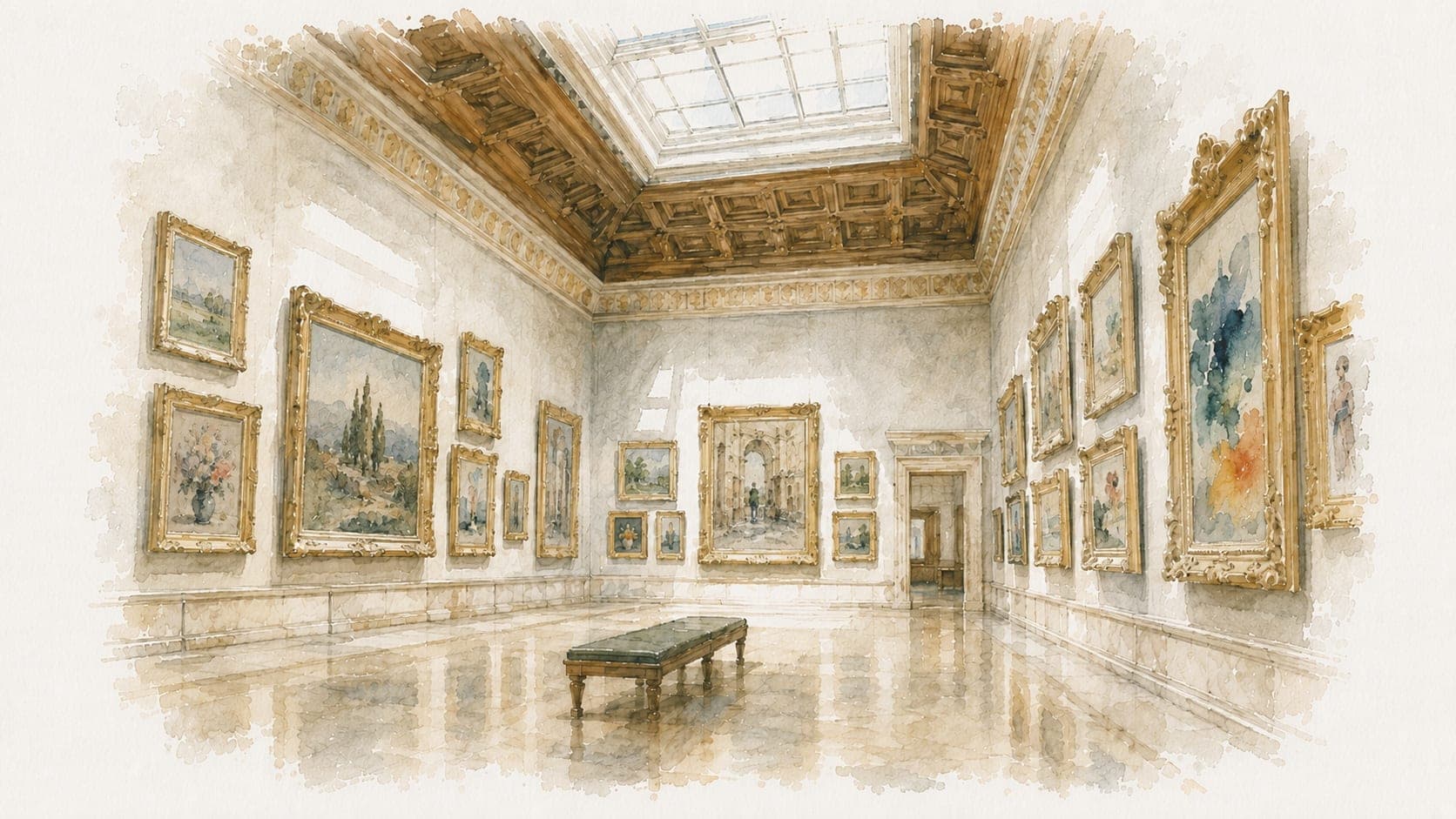
Art & Colour
Gallerie dell’Accademia: a private guided tour
Titian, Veronese, Tintoretto, and the invention of Venetian colour
Venetian painting developed apart from Florence and Rome, and the difference is not one of manner but of method. In Florence drawing comes first: the composition is set out in line and the colour applied afterwards. In Venice colour comes first, and form emerges out of the paint itself. Everything later called painterly begins here and runs forward as far as the Impressionists.
Programme
- Why this building The gallery occupies the former Scuola della Carità. The collection is arranged not as a store of masterpieces but as a chronology: five centuries in sequence, and you watch a way of seeing change.
- Bellini and the beginning Soft light, and landscape as a participant in the scene rather than a backdrop.
- Giorgione’s Tempest A painting whose subject has been argued over for five hundred years. The absence of a clear story is not a puzzle but a turn: painting admits mood in place of narrative.
- Titian How paint becomes living flesh. In the late works the brushstroke is visible and deliberately unsmoothed — the quality that was still being copied three centuries later.
- Veronese on trial The Feast in the House of Levi was painted as a Last Supper. Because of the dogs, the jesters and the company at the table, the artist was summoned before the Inquisition in 1573. He did not repaint the canvas. He renamed it.
Route
- Why this building The gallery occupies the former Scuola della Carità. The collection is arranged not as a store of masterpieces but as a chronology: five centuries in sequence, and you watch a way of seeing change.
- Bellini and the beginning Soft light, and landscape as a participant in the scene rather than a backdrop. With Giovanni Bellini the Venetian school starts.
- Giorgione’s Tempest A painting whose subject has been argued over for five hundred years. The absence of a clear story is not a puzzle but a turn: painting begins to admit mood in place of narrative.
- Titian How paint becomes living flesh. In the late works the brushstroke is left visible and deliberately unsmoothed — the quality still being copied three centuries later.
- Veronese on trial The Feast in the House of Levi was painted as a Last Supper. On account of the dogs, the jesters and the company at the table the artist was summoned before the Inquisition in 1573. He did not repaint the canvas; he renamed it. We look at both the painting and the record of the hearing.
- Tintoretto and the Carpaccio cycle Mystery, movement and light in the first; narrative precision and civic reportage in the second. The Saint Ursula cycle doubles as a document of how Venice looked in the fifteenth century.
How this differs
An ordinary museum visit is a circuit of rooms with labels. Here we look at no more than fifteen works and take each apart: what a contemporary saw, what we no longer notice, how it is made, and why it constituted a turn. The aim is not to show more but to teach reading.
Not for you if
- If you want to see the maximum number of rooms in the minimum time, the pace here is different.
- If contemporary art interests you more than the classical, the Peggy Guggenheim and the Punta della Dogana are nearby and we can discuss a swap.
- Children under ten generally tire: two hours of talk about painting is heavy going.
When to go
| All year | Indoors. In high water and rain, one of the better options in the city. |
|---|---|
| Weekday mornings | Optimal. Weekends and afternoons are noticeably denser. |
What the price covers
- A licensed private guide
- A route built around your pace and interests
- Reservation and priority entry
Paid separately
- Gallery admission, paid separately
- Transport
- Food and drink
The quoted price covers one to three guests. From four upwards, quoted on request.
Practical notes
- Meeting point
- The gallery entrance, or your hotel
- Tickets
- Reserved in advance, paid separately
- Best hours
- A weekday morning
Frequently asked
Do I need any background in art history?
None. The route is built from the ground up, but without simplification.
Is admission included?
No, it is paid separately. Reservation and priority entry are my part.
How many works do we see?
No more than fifteen. The point is depth, not quantity.
Can the Peggy Guggenheim be added?
Yes, the two are ten minutes apart. A full day across both collections is arranged separately.
Is there any point if I know nothing about painting?
That is precisely when there is a point. Knowing is not a condition of entry; it is the result.
How many rooms do we cover?
Not all of them, deliberately. About fifteen works across the sequence that matters.
Can it be combined with the Frari or San Rocco?
Yes, and Tintoretto at San Rocco makes an excellent second half. That becomes a half-day.
Available dates and a quote for your party — in reply to a short message.
Get in touchOther tours in Venice
Doge’s Palace tour with skip-the-line entry
The machinery of power: from the gilded halls to the prisons
A visit to a private palazzo in Venice
Lived-in houses, and the families who receive you
Jewish Ghetto of Venice: a guided walk in Cannaregio
The first ghetto in the world, and an island within an island