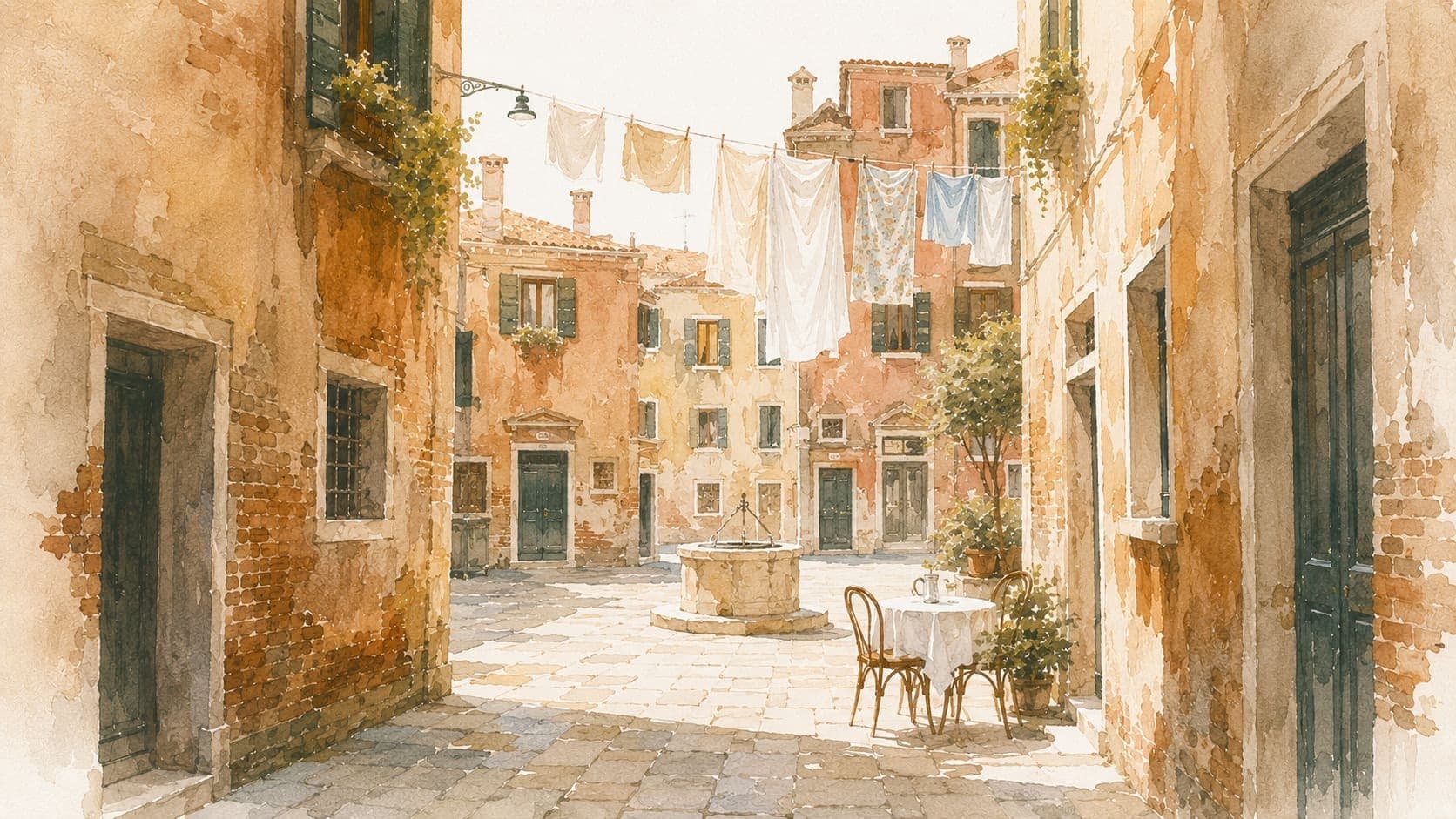
Vertical City
Jewish Ghetto of Venice: a guided walk in Cannaregio
The first ghetto in the world, and an island within an island
The word ghetto was born here. In 1516 Venice assigned its Jewish community a plot on the site of a former foundry — geto in Venetian, from the verb to pour. The name of a place became a term that spread across Europe. This is the first quarter of its kind anywhere, and its architecture still explains how it worked.
Programme
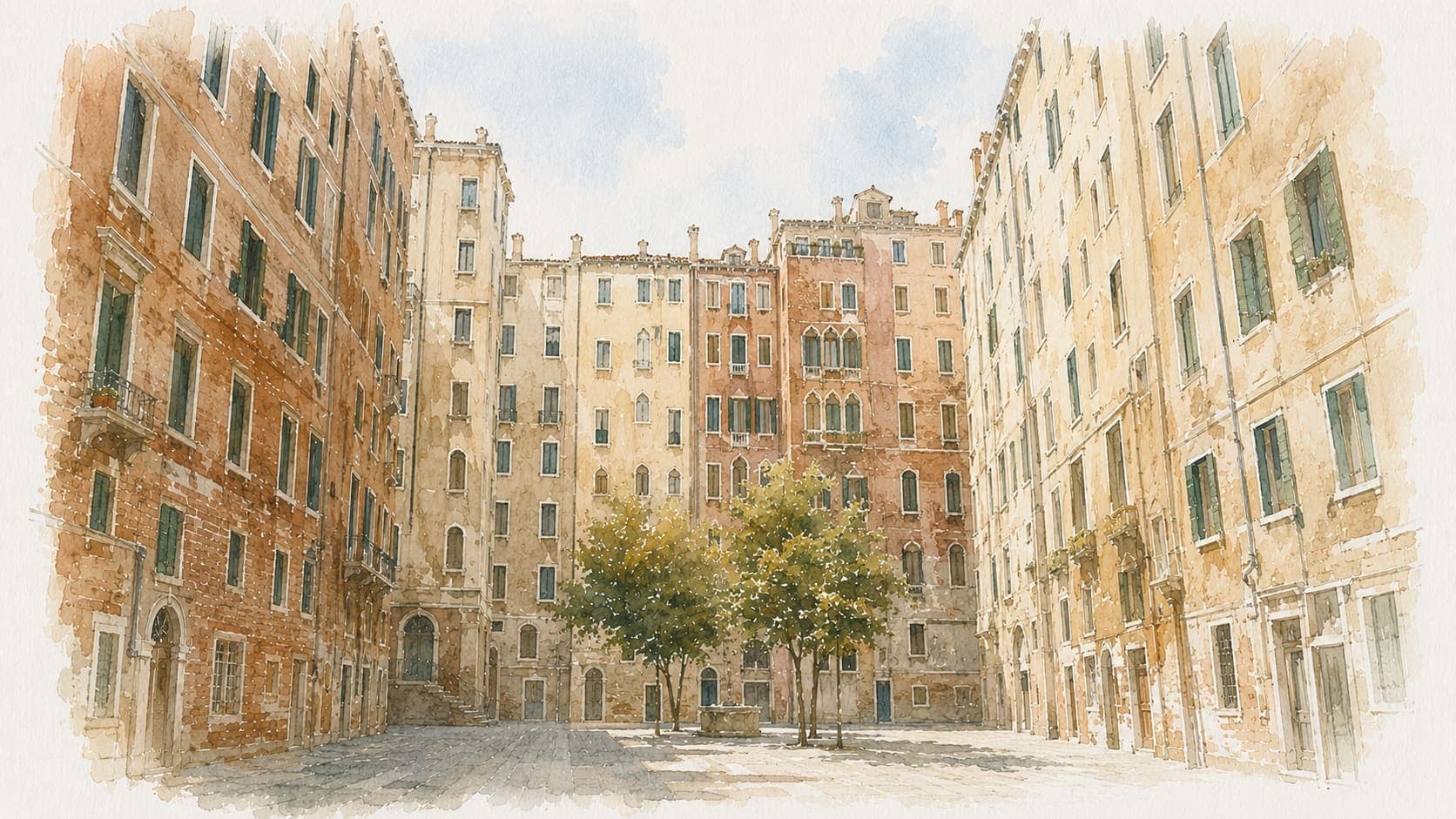
- Why the buildings are tall There was nowhere to expand: the plot was bounded by canals and the community grew. They built upward, adding storeys with low ceilings — up to seven where the rest of the city has three or four. Nowhere else in Venice looks like this.
- Three parts of the quarter Ghetto Nuovo, Vecchio and Nuovissimo appeared as the population grew. How the rules shifted: the hours the gates were locked, who could leave, which trades were open.
- Synagogues in plain sight From outside, ordinary residential fronts — they were not permitted to stand out. Inside: gilding, carved wood and marble. There are five, each built by a different community. The differences between them are a map of migration.
- Physicians, bankers, printers The Republic restricted the community and depended on it at once. Venetian Jewish presses published books that circulated across Europe.
- Shylock and reputation Shakespeare wrote The Merchant of Venice without ever setting foot in the city, and the literary figure shaped opinion more forcefully than any document.
Route
- Why the buildings are tall There was nowhere to expand: canals bounded the plot and the community grew. They built upward, adding storeys with low ceilings, reaching six and seven where the rest of the city has three or four. It is the only place in Venice where the buildings read as medieval towers.
- Three parts of the quarter Ghetto Nuovo, Vecchio and Nuovissimo appeared as the population grew. How the rules shifted with them: the hours the gates were locked, who was permitted to leave, which trades were open.
- Synagogues in plain sight From the outside, ordinary residential fronts — they were not permitted to stand out. Inside, gilding, carved wood and marble. There are five, each raised by a different community: German, Italian, Levantine, Spanish. The differences between them are a map of migration.
- Physicians, bankers, printers The Republic restricted the community in law and depended on it in practice: medicine, credit and printing rested substantially upon it. Venetian Jewish presses produced books that circulated across Europe.
- Shylock and reputation Shakespeare wrote The Merchant of Venice without ever visiting the city, and the literary figure shaped opinion more powerfully than the documents did.
- Cannaregio around it We come out into the district that remains the most lived-in part of the historic centre: quaysides where people sit, shops serving residents, and almost no souvenir windows.
How this differs
Group routes usually pass through for twenty minutes between other stops. Here the quarter is a subject in its own right for two hours, with an account of how it worked rather than a recitation of facts. It is the one itinerary in the catalogue concerned with how the city dealt with people it needed and found inconvenient at the same time.
Not for you if
- The subject is serious and treated seriously — heavy going for children below their teens.
- On Shabbat and Jewish holidays the synagogues are closed and there is no interior access. The walk still works.
- If you want an easy stroll with views, this is a different register.
When to go
| All year | The quarter is compact and there is little walking. |
|---|---|
| Sunday to Thursday | Synagogue visits are possible. Friday afternoon and Saturday, closed. |
| Morning | Better: groups tend to arrive at the community museum after midday. |
What the price covers
- A licensed private guide
- A route built around your pace and interests
Paid separately
- Synagogue and museum admission
- Transport
- Food and drink
The quoted price covers one to three guests. From four upwards, quoted on request.
Practical notes
- Meeting point
- Your hotel, or the Ponte delle Guglie
- Dress
- Modest: shoulders and knees covered for the religious sites
- Distance
- About two kilometres; the quarter is compact
Frequently asked
Do we go inside the synagogues?
Yes, when they are open. Access runs through the community museum with an escort; admission is paid separately and the schedule depends on the day and on holidays.
Where does the word ghetto come from?
From the Venetian geto, a foundry. The quarter was assigned on the site of a former foundry in 1516, and the name of the place became a common noun.
Is there a dress code?
Shoulders and knees covered for the religious sites. Men are given a head covering on arrival.
Does anyone still live there?
Yes. The community in Venice is small but active: a working synagogue, a bakery and a care home. This is not a museum quarter.
Is it open on Saturdays?
The synagogues are closed on Shabbat. A walk through the quarter is still possible.
How many synagogues are there and do we see them all?
Five. Access runs through the community museum and typically covers two or three, depending on the day and on services.
Is the subject handled sensitively?
It is handled as history, without either sentimentality or evasion. If you are visiting with children, tell me their ages and I adjust.
Is there anywhere to eat nearby?
Yes, there is a kosher bakery and a couple of small places in the quarter. I can point you to them at the end.
Available dates and a quote for your party — in reply to a short message.
Get in touchOther tours in Venice
Gallerie dell’Accademia: a private guided tour
Titian, Veronese, Tintoretto, and the invention of Venetian colour
Venice artisan workshops: a private studio tour
Closed studios, and the people who have kept the trades alive
Private walking tour of Venice with a licensed guide
The city without its mask: from the main squares to the quiet quarters