Artisan
Venice artisan workshops: a private studio tour
Closed studios, and the people who have kept the trades alive
Venice was an industrial city long before it became a visited one. Glass, textiles, printing and shipbuilding carried the economy of the Republic, and some of those trades survive. But working studios do not run on footfall: they have no shopfronts on the busy streets and they do not take groups off the pavement.
Programme
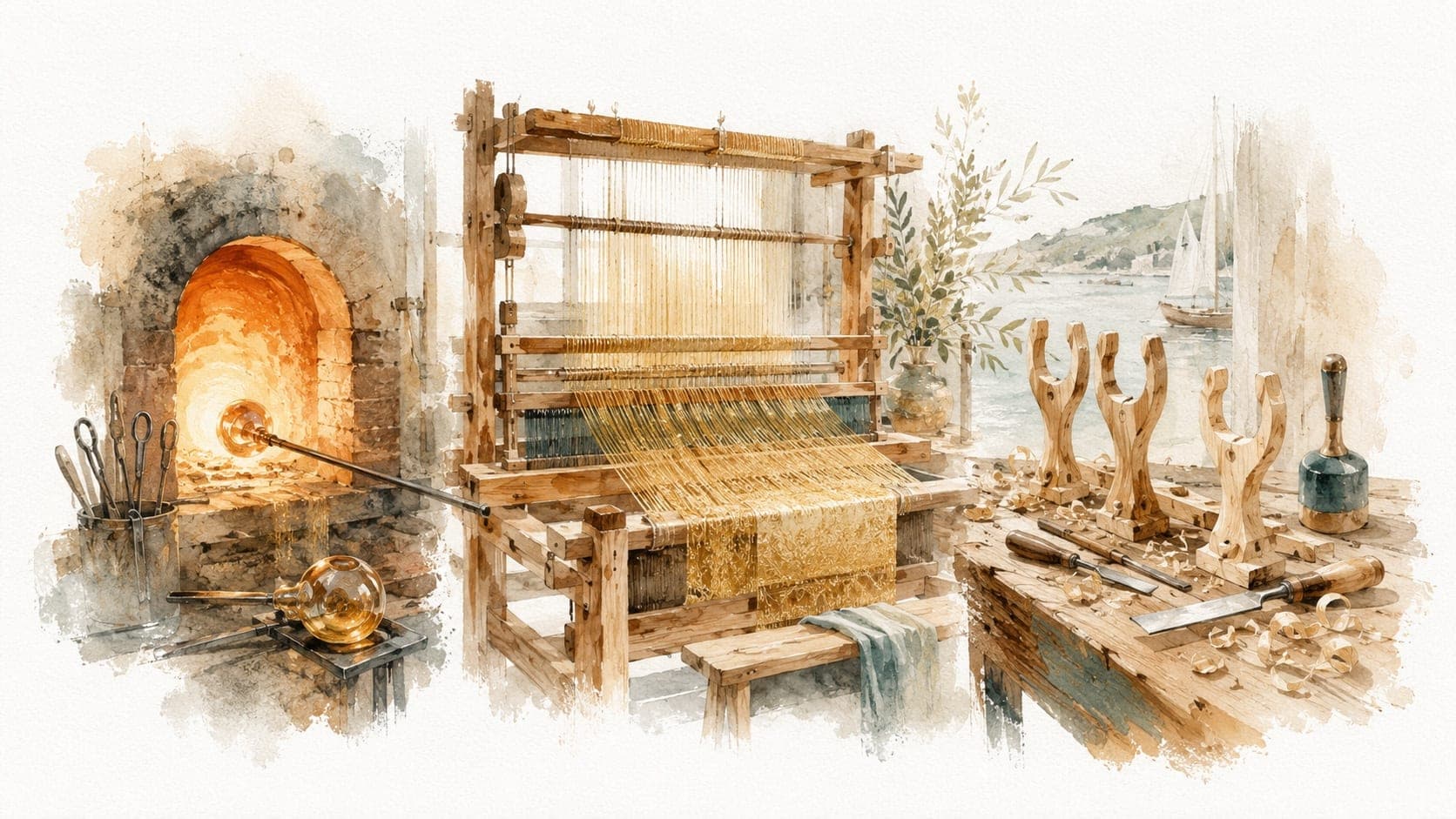
- Smalto and fire A workshop making smalto — the opaque glass used in mosaic. We watch colour emerge from the batch in the furnace, and why gold smalto is made with a genuine leaf of gold laid between two layers of glass. The material goes out to cathedral restorations around the world.
- Cloth on old looms A manufactory weaving velvet and brocade by hand to eighteenth-century methods. Progress is measured in centimetres a day. Why a machined imitation never gives the same travel of light across the pile.
- The forcola The oarlock of a gondola is not a fitting but a sculpture, cut from walnut to a particular oarsman: his height, his weight, his stroke. One of the rarest trades in the city, with a handful of makers left.
- The economics of craft Why real work costs what it costs: the years of training, the expense of keeping a furnace lit, and why an object at twenty euros cannot be Venetian.
Route
- Smalto and fire A workshop making smalto, the opaque glass used in mosaic. We watch colour emerge from the batch in the furnace, and see why gold smalto is made with a genuine leaf of gold laid between two layers of glass. The material goes out to cathedral restorations around the world.
- Cloth on old looms A manufactory weaving velvet and brocade by hand to eighteenth-century methods. Progress is measured in centimetres a day. Why a machined imitation never reproduces the same travel of light across the pile.
- The forcola The oarlock of a gondola is not a fitting but a sculpture, cut from walnut to a particular oarsman: his height, his weight, his stroke. One of the rarest trades in the city, with a handful of makers left.
- The economics of craft Why the real thing costs what it costs: the years of training, the expense of keeping a furnace lit, and why an object at twenty euros cannot have been made here.
- How to buy If you want to commission something, I explain how it is done directly with the maker, without gallery mark-up, and how shipping is arranged.
How this differs
The usual workshop tour is a run to a showroom that pays for the delivery of groups. Here we go where people are working rather than selling: the route is assembled the day before around the makers’ own hours, and nobody takes a percentage of what you buy. That is also why the order and the composition can change.
Not for you if
- Most studios are closed at weekends — plan for a weekday.
- If the aim is to buy souvenirs quickly, this is the wrong route: here you watch work.
- Studios can be hot, loud and dusty. They are workplaces, not galleries.
When to go
| Weekdays | A condition rather than a preference. A minority open on Saturday; almost none on Sunday. |
|---|---|
| September | A particular month: during Homo Faber and Glass Week, makers who are normally closed open their doors. |
| August | Difficult. Many studios close for two or three weeks. |
What the price covers
- A licensed private guide
- A route built around your pace and interests
- Arranging the workshop visits
Paid separately
- Purchases from the makers
- Transport
- Food and drink
The quoted price covers one to three guests. From four upwards, quoted on request.
Practical notes
- Meeting point
- Your hotel, or an agreed point in Cannaregio
- Schedule
- Set by the makers: the route is confirmed the day before
- Buying
- Optional, and direct from the maker without gallery mark-up
- Best days
- Weekdays; most studios are shut at weekends
Frequently asked
Am I expected to buy anything?
No. These are studio visits; buying is entirely optional and nobody will press you.
Can I commission a piece?
Yes, directly from the maker without a gallery mark-up. The studios arrange shipping themselves.
Are the workshops open at weekends?
Generally not. Plan for a weekday.
Why is the route confirmed only the day before?
Because we go to people who are working, not to a showroom. Each keeps their own hours.
Is it suitable for children?
Yes. The furnace is the strongest impression in Venice for a child. From six upwards, closed shoes.
May I try something myself?
In some studios, yes, and it is agreed beforehand. At the furnace the scope is limited for safety.
Can a piece be shipped home?
Yes, directly from the maker. The studios handle packing and worldwide shipping themselves.
Is photography allowed?
In most studios, yes, by permission. Some techniques are not photographed, and I will say so.
Available dates and a quote for your party — in reply to a short message.
Get in touchOther tours in Venice
Murano, Burano and Torcello by private boat
Glass, lace and the quiet end of the lagoon
Jewish Ghetto of Venice: a guided walk in Cannaregio
The first ghetto in the world, and an island within an island
Private walking tour of Venice with a licensed guide
The city without its mask: from the main squares to the quiet quarters