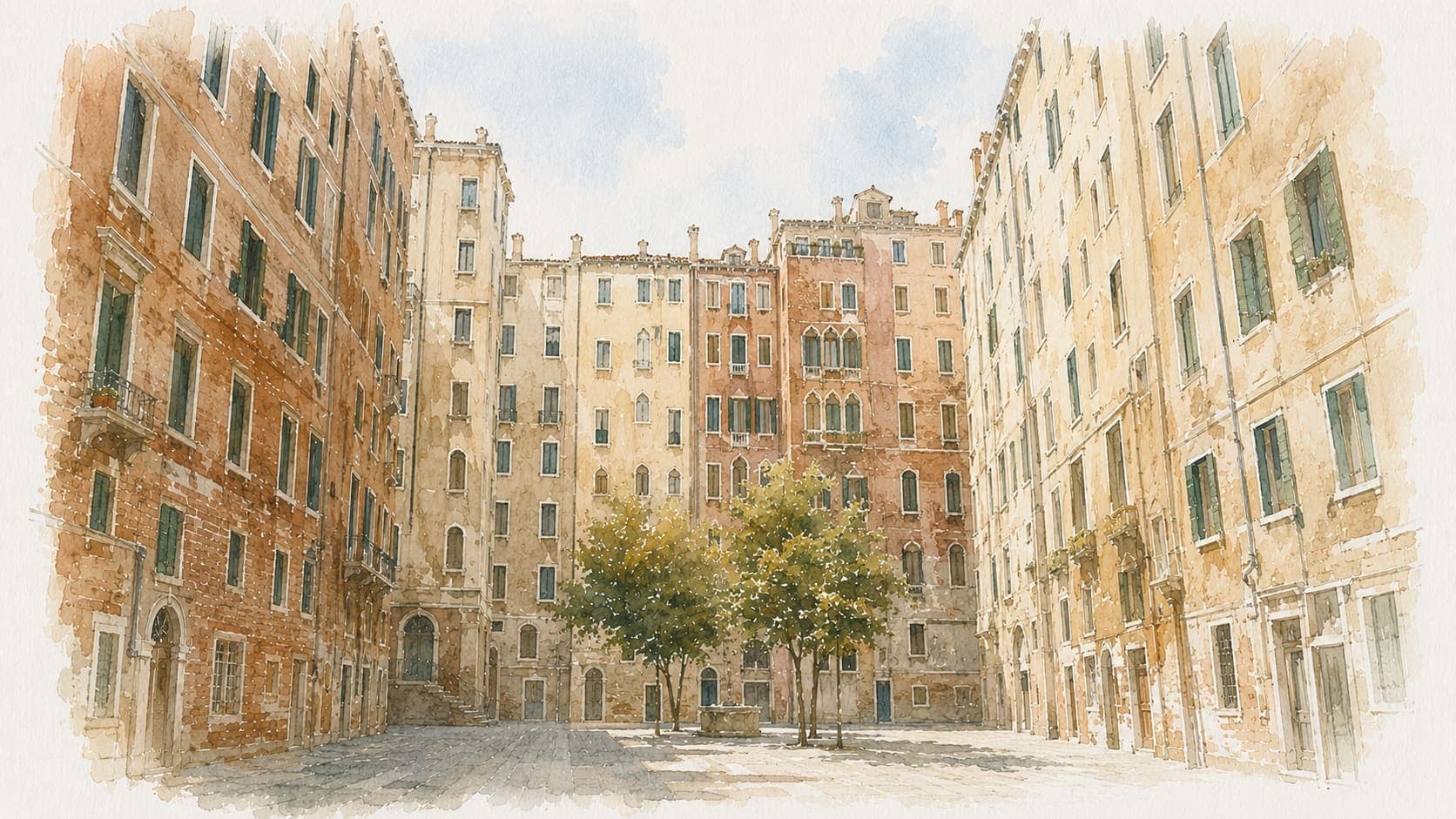
Venetian Initiation
Private walking tour of Venice with a licensed guide
The city without its mask: from the main squares to the quiet quarters
Venice was laid out as a labyrinth on purpose: narrow calli, dead ends at the water, squares that arrive without warning. The plan answered to defence and trade, not to the convenience of a visitor. A first day here therefore either sets the tone for the whole trip or eats it — walking the treadmill between San Marco and Rialto, seeing crowds, and leaving with the impression that the city is overrated.
Programme
- The strategy of San Marco We reach the square in the golden hour, when it holds the grandeur of the Doges rather than the churn of tour groups.
- Reading the city You learn to read the signs on the facades, and why the gondolas are black.
- Away from the route We leave the worn path for Castello or San Polo: washing on lines, coffee in the air, water audible again.
- The ritual A traghetto crossing of the Canal Grande, and a first properly made spritz.
Venice cannot be viewed. It can only be lived in for a while. My work is to make you feel local for the length of an afternoon.
Route
- San Marco at the right hour The square only reads when there is no queue on it. Why the basilica resembles no other church in Italy: it was built as a Byzantine rather than a Roman structure, and the spoils on its facade are part of a statement about how the Republic saw itself.
- How the city is organised Six sestieri instead of named streets, house numbers running within the district rather than along a road, and street names painted straight onto the wall. Once the system is explained you stop being lost and start reading addresses.
- Signs on the facades Coats of arms, reliefs, bricked-up openings, the traces of earlier owners. A house in Venice is a document, and after this part of the walk you begin to see text where there was decoration.
- Why the gondolas are black Not because of the plague, as the story usually runs. The reason is sumptuary law: in the sixteenth century the Republic forbade decorating boats so that wealthy families could not compete in public. The black is what regulation left behind.
- Into the living quarters Castello or San Polo — districts where people live rather than serve. Washing between the houses, children in the courtyard, shops for residents. The contrast with San Marco is such that it seems a different city.
- Traghetto and a first spritz Crossing the Canal Grande standing up on a working gondola, which is how Venetians do it. We finish in a bacaro, where I explain how to order and how to read the bill.
How this differs
A group walking tour follows a fixed loop pitched at the average interest of twenty strangers. Here the route is assembled around you: if architecture holds you, we linger at the facades; if it is food, we reach the bacaro sooner; if you are tired, we sit down rather than press on to a schedule.
Not for you if
- If you want to go inside museums — this is a tour of the city. The Palazzo Ducale and the Accademia are separate itineraries.
- If the priority is photography, the pace is different here; we shoot in passing.
- If this is not your first visit and you want depth, take one of the Deeper routes — this one will feel like a summary.
When to go
| April to May | The best window. Soft light, a temperature that allows long walking, crowds still tolerable. |
|---|---|
| July to August | Early morning or after six. At ninety per cent humidity a midday walk becomes an endurance test. |
| September to October | The best light of the year for photographs. |
| November to February | An empty city and fog. Dress in layers and bring waterproof footwear. |
What the price covers
- A licensed private guide
- A route built around your pace and interests
- The traghetto crossing
- Help planning the rest of your days
Paid separately
- Museum and site admission
- Transport, unless stated in the description
- Food and drink
The quoted price covers one to three guests. From four upwards, quoted on request.
Practical notes
- Meeting point
- The columns on Piazza San Marco, or your hotel lobby
- Distance
- Three to four kilometres at an unhurried pace, with stops
- Footwear
- Comfortable: Venice is built on bridges with steps
- Best hours
- Early morning, or after six in the evening
- In rain
- The tour runs; the route moves to arcades and churches
- Optional extra
- A visit to St Mark's Basilica: +1 hour, from €100
Frequently asked
How much walking is involved?
Three to four kilometres at a comfortable pace with stops. Venice is a walking city, but the route is built around your rhythm.
Do we go inside any museums?
No, this is a tour of the city. Interiors are covered by other itineraries: the Palazzo Ducale and the Accademia.
Is the tour in English?
Yes. I also work in Russian and Italian.
Can children come?
Yes. For children of eight to twelve there is a separate quest-style route.
What if my flight is delayed?
Tell me and we move the time. If the day is lost entirely, I look for another window.
Do you run tours in winter?
All year. Winter is the best season in Venice: the city is empty and the light is soft.
Is it worth taking if I only have one day in Venice?
That is exactly when it is worth taking. Two hours gives you the map of the city in your head, and you spend the rest of the day going somewhere rather than working out how to get there.
Do we go inside the Basilica?
Not on this itinerary — entry is separate and comes with a queue. I explain how and when to go on your own, or we arrange a separate visit.
Can we start from my hotel?
Yes, we meet in the lobby. If the hotel is well outside the historic centre we agree a convenient point.
Available dates and a quote for your party — in reply to a short message.
Get in touchOther tours in Venice
Venice evening walk: legends, intrigue and the empty city
Ghosts, alchemists and secret societies, with the record kept straight
Doge’s Palace tour with skip-the-line entry
The machinery of power: from the gilded halls to the prisons
Venice artisan workshops: a private studio tour
Closed studios, and the people who have kept the trades alive