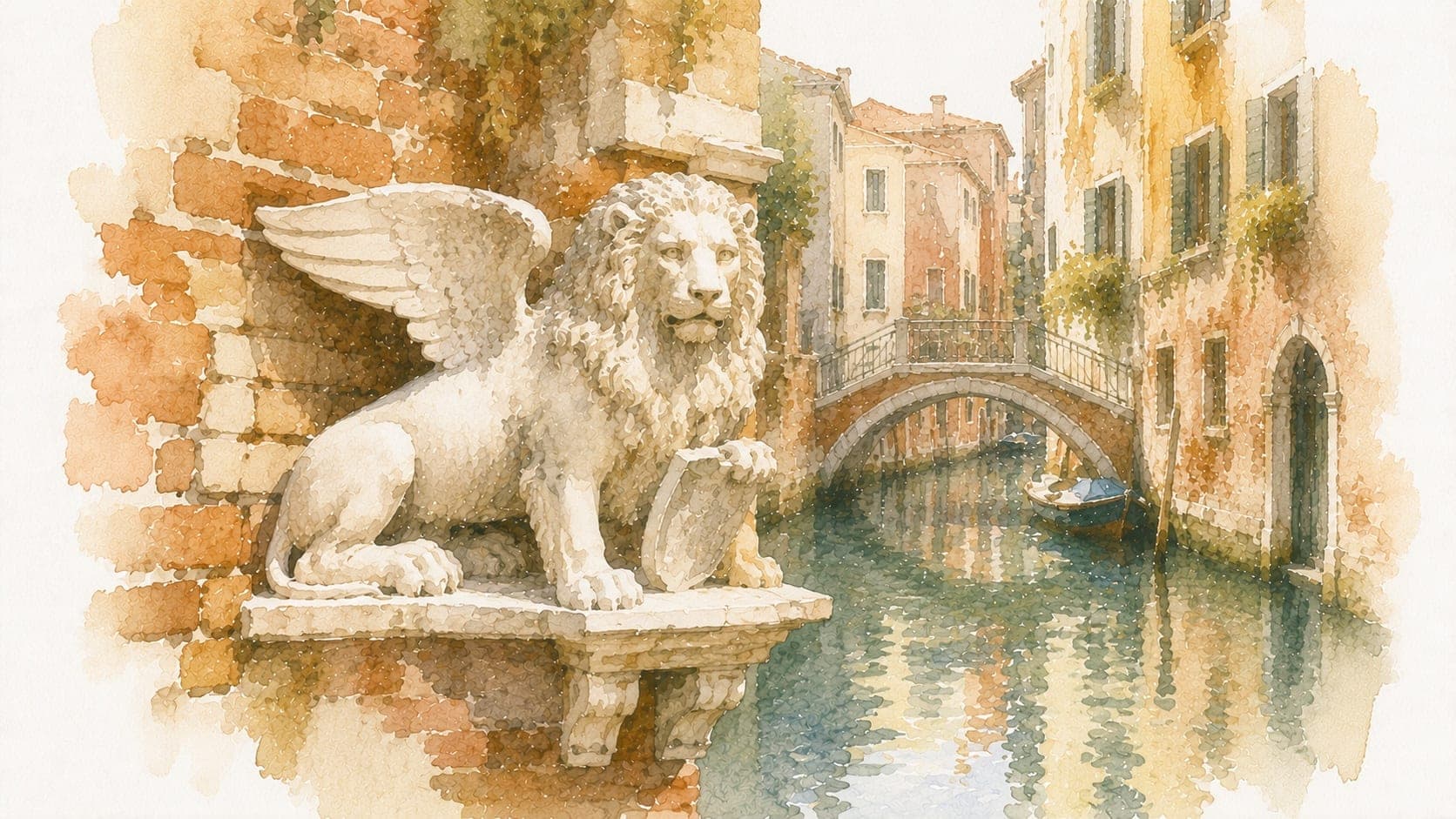
Lion Hunt
Venice family tour for children: a lion hunt
A quest through the city, and parents who get to look at it
A child is bored in Venice right up to the moment the city turns into a problem to be solved. There are no cars, the houses stand on water, and winged lions sit on the walls. The material for an expedition is already here; all that is required is to stop reading dates aloud.
Programme
- What the winged lion is The symbol of Saint Mark and the arms of the Republic. The lions differ: book open or closed, seated or striding, carved or cast. Once the code is explained, children start finding them without help.
- The hunt We look for lions on cornices, above doorways, on well-heads and bridges, and count what we find. Adults are usually drawn in by the fourth.
- Why the city stands on water Larch piles driven into the silt, which do not rot without air, and a timber platform laid across them. Every child asks whether it will sink, and so does half of every set of parents.
- Why the water is green Not from dirt. Where the colour comes from, what a tide is, and why the level changes twice a day.
- Masks and who wore them Not only at carnival: masks were worn on ordinary days, and there were practical reasons for it.
- Gelato in a hidden courtyard A stop for the best ice cream away from the queues, and a note for the parents on telling real gelato from industrial.
While the children are busy hunting, you get the city without complaints.
Route
- What the winged lion is The symbol of Saint Mark and the arms of the Republic. The lions differ: book open or closed, seated or striding, carved or cast. Once the code is explained, children begin finding them unaided across the whole city.
- The hunt We look for lions on cornices, above doorways, on well-heads and bridges, and we count. Adults are usually drawn in by the fourth.
- Why the city stands on water Larch piles driven into the silt, which do not rot without air, and a timber platform laid across them. Every child asks whether it will sink, and so does half of every set of parents.
- Why the water is green Not from dirt. Where the colour comes from, what a tide is, and why the level changes twice a day.
- Masks and who wore them Not only at carnival. Masks were worn on ordinary days and there were practical reasons for it. The best-known shapes and what each of them meant.
- Gelato in a hidden courtyard A stop for the best ice cream away from the queues, and a note for the parents on telling real gelato from the industrial sort.
How this differs
The usual family tour is an adult route with half of it removed. This is the reverse: the route is built from the child outward, and the adult gets a proper conversation running alongside. While the children are occupied, you get the city without complaints.
Not for you if
- Under six: shorter and without the quest — we discuss that separately.
- Teenagers over fourteen are generally bored; the walking tour or the evening route suits them better.
- If the parents want a full lecture on history, this is a different register.
When to go
| April to June, September | The best window: warm without being punishing, the city tolerably full. |
|---|---|
| July to August | Mornings only. In heat children switch off within an hour. |
| Rain | We move to the natural history museum, which has a dinosaur skeleton, or go and paint masks. |
What the price covers
- A licensed private guide
- A route built around your pace and interests
- Quest materials
Paid separately
- Gelato and drinks
- Admission, if we go inside
- Transport
The quoted price covers one to three guests. From four upwards, quoted on request.
Practical notes
- Age
- Best suited to eight to twelve
- Meeting point
- Your hotel, or Piazza San Marco
- Pace
- Frequent stops; built so that legs do not give out
- In rain
- The natural history museum with its dinosaur skeleton, or mask painting
Frequently asked
What age is it for?
Eight to twelve works best. For younger children we shorten the route; for older ones the material goes deeper.
How much walking?
About two kilometres with frequent stops, built so that children do not tire.
What if it rains?
We move to the natural history museum, which has a dinosaur skeleton, or go and paint masks.
Do the parents come along?
Yes, of course. The children are occupied; you get to look at the city.
What if I have two children of different ages?
Common enough. Tasks are set at different levels and the elder helps the younger, which works best of all.
What if my child is shy?
The quest does not require performing. I find the first few myself and almost everyone joins in after that.
Can we go at our own pace?
That is the point of a private route. If the child wants to stop and look at boats for ten minutes, we stop.
Do you speak to the children directly?
Yes, in English or Russian. The parents get the longer version alongside.
Available dates and a quote for your party — in reply to a short message.
Get in touchOther tours in Venice
Murano, Burano and Torcello by private boat
Glass, lace and the quiet end of the lagoon
Venice artisan workshops: a private studio tour
Closed studios, and the people who have kept the trades alive
Private walking tour of Venice with a licensed guide
The city without its mask: from the main squares to the quiet quarters