Is Venice Sinking? The Facts Behind the Headlines
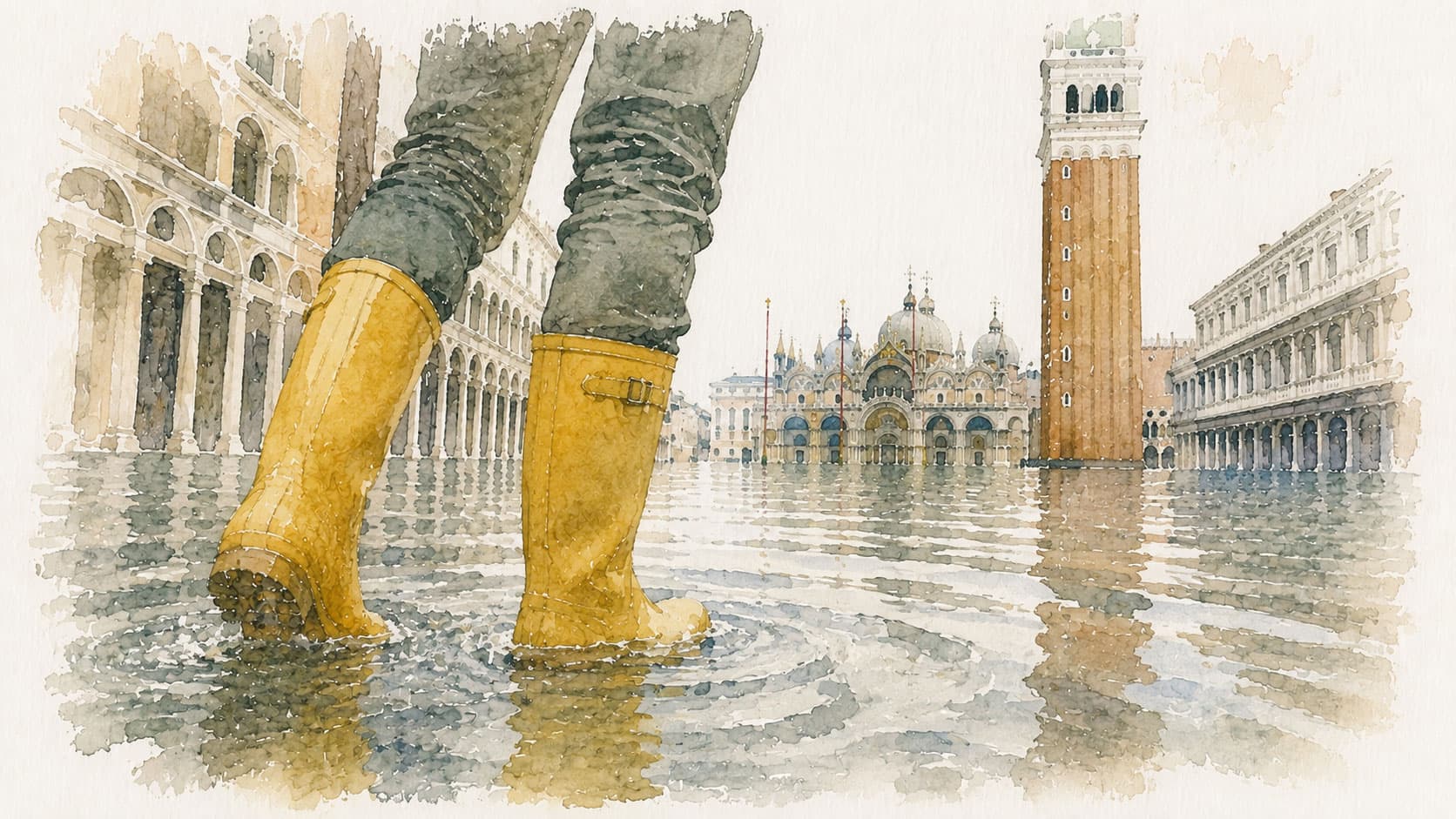
Every few months, the world's headlines bury Venice. The illustration is always the same: tourists wading knee-deep across St Mark's Square, beneath a caption promising the city is about to vanish for good. It's a lovely, viral story — and almost always wrong. Not because Venice faces no threat: the threat is real. But because the headlines confuse the cause, the mechanism and the timeline.
Let's work through it calmly and by the numbers: what's true here, what's myth, and what's simply panic for clicks. No soothing "it's all fine," and no apocalypse. Only what the data show.
Myth one: Venice is rapidly sinking
Start with the key word — "sinking." Yes, over the 20th century the city dropped by roughly 23–25 centimetres relative to the sea. But that figure comes in two halves: about half is the land itself subsiding, the other half is the sea rising. And here is the fact that won't fit in a headline: the fast subsidence was man-made.
In the post-war decades, the industrial zone of Marghera on the mainland pumped groundwater from beneath the lagoon on an enormous scale. The ground under the city settled in response: in the Mestre area, in 1968–1969, the rate of subsidence reached 17 millimetres a year — a great deal. After the catastrophic flood of 1966, the problem was finally taken seriously, and in the 1970s the pumping was sharply curbed: water consumption in Marghera fell from 500 litres a second in 1969 to 170 by 1975.
The result was almost immediate. The subsidence didn't merely slow — it stopped, and in places the ground even rebounded by around 2 centimetres. Today the city settles by 1–2 millimetres a year, and that is nature now, not a pump: the slow movement of the Adriatic plate and the compaction of ancient sediments. As Pietro Teatini of the University of Padua puts it, one millimetre a year is nothing beside what was happening thirty years ago.
The verdict. "Venice is rapidly sinking" is half-century-old news. The fastest phase was of our own making, and we stopped it ourselves in the 1970s.
What you see in the photographs is not "the city going under"
Now for those shots of a flooded St Mark's. This is acqua alta — "high water" — and it is not the city slowly submerging but a periodic tide. It has existed for centuries and recedes within hours, with the ebb.
The mechanism is simple. When a strong southerly sirocco drives water up the narrow Adriatic and into the lagoon, and a high astronomical tide and low pressure pile on top, the level rises and floods the lowest places. And the lowest place in the city is precisely St Mark's Square: it begins to flood at a tide of just 80–90 centimetres. It goes under first, and so it lands in every photograph, creating the misleading impression that "all of Venice is drowning." It isn't the whole city that floods — only its lowest point.
The scale of a genuine event looks quite different. On 4 November 1966 the water reached 194 centimetres — the highest ever recorded, and the disaster that transformed how the city was regarded. On 12 November 2019 it reached 187 centimetres, the second-highest ever: St Mark's and the Basilica went under. Those are floods. The ankle-deep puddle a tourist films on the square is an ordinary tide.
Myth two: nothing can be done about it
This is where MOSE comes in — a system of 78 mobile gates sealing the three inlets into the lagoon: Lido, Malamocco and Chioggia. On ordinary days the gates lie on the seabed, out of sight; when the forecast warns of a dangerous tide, compressed air is pumped in, they rise, and they cut the lagoon off from the sea.
They were raised for the first time on 3 October 2020 — and while the Adriatic outside rose above a metre and a half, the alleys inside the city stayed dry. In its first four years MOSE has closed around a hundred times: 25 in 2023, 28 in 2024. Today the system reliably holds back tides of up to three metres — meaning it would stop a repeat of 1966 without difficulty. In 2024 alone the barrier prevented damage estimated at €200–400 million.
Was it expensive? Yes — construction cost roughly €6–7 billion, dragged on for twenty years, and came with a loud corruption scandal, delays and technical problems. There was a failure, too: in November 2020 a forecasting error meant the gates weren't raised in time, and the city flooded after all. But the fact stands: the same tides that once paralysed Venice now pass unnoticed.
The verdict. "Nothing can be done" is untrue. Since 2020 the city has come through its high water dry.
Where myth meets fact: the real threat is the sea, not subsidence
And now the honest part, for which the whole piece exists. A good story always has a grain of truth, and here it is this: Venice really is threatened by water — only not from below, but from the sea. Not by subsidence, but by the rise of the Adriatic.
The projections in the IPCC's Sixth Assessment Report for this region: by 2100 the sea will rise by roughly 28–55 centimetres under an optimistic scenario, and 63–101 centimetres under a pessimistic one. And the problem is less the figure itself than the frequency. High tides are already growing more common: events above 110 centimetres numbered 58 in 2019–2023, against 24 in 2009–2013. Which means MOSE will have to close ever more often: by one estimate, around 19 days a year by 2050 and up to 150 days a year by the century's end.
Here is where the real risk lies. The gates are not watertight, and rain and the rivers flowing into the lagoon from the mainland add their share too. Every long closure hits the port and the ecology of the lagoon: the water stops exchanging with the sea. Researchers estimate that, with additional measures, MOSE is effective up to about 1.25 metres of rise — beyond that line, far more radical solutions will be needed. More than half the city sits at 0.8–1.2 metres above mean sea level, and the tidal range is around a metre. The margin, frankly, is thin.
So will Venice disappear?
The short answer: not tomorrow, and not in the coming decades — but this is a managed, century-long struggle that the city is winning for now, and could lose if it stops acting.
The "city going under" headlines get the physics wrong: the fast subsidence ended half a century ago. Those who wave it away — "it's all fine, MOSE will save it" — get the timeline wrong: in the second half of the century both the barrier's limit and the health of the lagoon become a serious problem. The truth is in between, and it's more interesting than either extreme: Venice is not sinking of its own accord; it is playing a long engineering game against the sea. The outcome depends on emissions, and on whether the defences keep being built.
Quick reference
- "Venice is rapidly sinking"
- a myth: the fast phase was man-made and stopped in the 1970s; today it's 1–2 mm a year.
- A flooded St Mark's in a photo
- not the city submerging but acqua alta, a periodic tide; the square is simply the lowest point.
- The records: 194 cm in 1966 and 187 cm in 2019
- those are floods, not an ankle-deep puddle.
- MOSE
- has kept the city dry since 2020, has closed around 100 times, and would stop even a 1966-scale tide.
- The real threat is sea-level rise by the century's end and ever more frequent closures
- not subsidence.
Frequently asked
Is it true that Venice is sinking?
Not in the sense the headlines mean. The rapid 20th-century subsidence was caused by pumping groundwater for the industrial zone and was stopped by the restrictions of the 1970s; today the city settles by one to two millimetres a year from natural causes. The real long-term threat is not the land sinking but the sea rising.
Will Venice be gone soon?
No. The city is not going to disappear in the coming decades. This is a struggle with the sea spread across the whole century, one the MOSE system is winning for now. The long-term outcome depends on the rate of sea-level rise and on further defences.
What is acqua alta?
It's a periodic rise in water level, when a southerly wind and an astronomical tide drive Adriatic water into the lagoon and flood the lowest places — above all St Mark's Square. The water lasts a few hours and leaves with the ebb. It is not permanent flooding, and it happens mainly from autumn to early spring.
Does MOSE work?
Yes. The barrier was first raised on 3 October 2020, and has since closed around a hundred times, reliably protecting the city from tides of up to three metres. It would stop a repeat of the record 1966 flood. Its weak points are that the gates aren't watertight and that closures grow more frequent as the sea rises.
Should I visit Venice now, or "before it's too late"?
You should certainly visit, and the panic of "go before it goes under" has no place here — the city isn't going anywhere in the foreseeable future. Far more useful is choosing the season: high water peaks in November, but even then a tide lasts hours, not days, and a well-planned route simply avoids it.
Is high water dangerous for a visitor?
As a rule, no: it's an inconvenience, not a danger. The city posts the tidal forecast in advance, walkways are laid across the low-lying stretches, and MOSE holds back the genuinely high events. It's enough to watch the forecast and keep a pair of wellingtons to hand — or a guide who will simply rearrange the day so you walk on dry ground.
Venice isn't disappearing — but it's a city where it particularly pays to tell truth from hype, and not only for peace of mind. The high-water season has a beauty of its own: the Basilica mirrored in a flooded square at dawn is a sight some people come for on purpose. The only difference is whether you know when the water will arrive and where to go to escape it. A good guide checks the tide tables and rearranges the route so you catch the spectacular side of the phenomenon without wet feet. If you're planning a visit, tell us your dates and we'll tell you what to expect from the water during your stay, and build the day around it. And to see the city beyond the postcards right now, take our curated map of Venice with you.