Venice Tourist Scams: 7 Schemes Nobody Warns You About
Venice is not a dangerous city. No one will snatch your bag or corner you in a dark alley; the place is far more elegant than that. Venice is arranged so that what costs you money is not risk but ignorance. Almost every scheme here sits at the edge of the law, or squarely within it — and it works precisely because you don't know the fixed price, haven't read the small print, or aren't aware of how things are done.
The good news: all of it is avoidable once you understand the mechanics. Below are seven schemes the locals see every day, with the real 2026 prices and one simple rule against each. Not one of them happens to someone who knows how the city works.
The gondola: the price is fixed, the "surprises" are not
The gondola fare is set by the city. It is identical at every official station and displayed on a board: in 2026 it is €90 for 30 minutes by day (09:00–19:00) and €110 for 35 minutes in the evening (19:00–04:00). The crucial thing to know: the price is per boat, not per person. A gondola holds up to five passengers and the fare does not rise. Payment is cash only.
Where people lose money. The fare is quoted "per person." The ride is quietly shortened — you paid for thirty minutes and glide for twenty. Or you're told the song is "extra": a serenata, with a singer and an accordionist, is indeed a paid add-on from around €200, but it should be offered openly and in advance, not sprung on you in the middle of a canal. There may also be a surcharge for a "special route" you never asked for.
How not to fall for it. Remember you're paying for the boat. Before you step in, agree the route, the number of minutes and the total. If anyone quotes a per-person figure or a price noticeably above the tariff, walk calmly to the next official station — they are not permitted to exceed it. And if you simply need to cross the Grand Canal, take the traghetto — the same gondola as a ferry, for a couple of euros. If you would rather not check tariffs at all, the ride can be arranged in advance: your own route instead of the standard loop, boarding at the dock nearest your hotel, and the figure agreed beforehand. It costs more than the official tariff — what you are paying for is an evening without negotiations on the landing.
The bill by the water: coperto, "service" and fish "by weight"
The restaurants directly on St Mark's Square and at the foot of the Rialto, with a terrace and a tout waving you in, are the most expensive way to eat in Venice and the commonest source of an unpleasant bill. There are several mechanisms. The coperto is a per-person cover charge; it is legal and usually €2–6, but it must be stated on the menu. The servizio is a service charge of 10–12% sometimes added on top — check it hasn't been applied automatically. And the classic: fish and seafood "by weight," where the menu lists a price per 100 grams in small print, a large fish duly arrives, and the bill runs into three figures.
How not to fall for it. Walk one street back from the main squares — prices fall and quality rises. Sit only where you can see the prices before you sit down. For anything "by weight" or "at market price," ask the cost out loud, in advance. Photographs of dishes in the window and a "tourist menu" in five languages are a reliable sign of a place worth walking past. Where to go for the real thing rather than the trap — in our piece on bàcari and cicchetti.
The "free" boat to Murano
Near St Mark's or the Rialto, someone offers to take you to Murano for free, "to the glass factory." The boat really is free — because it delivers you to one particular showroom, where you'll be shown "a master at work," after which come the pressure and the prices you weren't prepared for. Getting back is your own problem.
How not to fall for it. Make your own way to Murano by vaporetto: line 3 from the station and Piazzale Roma, or 4.1/4.2 from Fondamente Nove — inexpensive, about ten minutes. Head for the working furnaces, not the "factory" shop, and buy only with the Vetro Artistico® Murano mark, the official proof of authenticity. The same goes for lace: genuine Burano lace is bought on Burano itself, from the women who make it, not in a shop full of fridge magnets by the square. How to tell real Murano glass from a fake — in a separate article.
The water taxi: the meter that isn't there
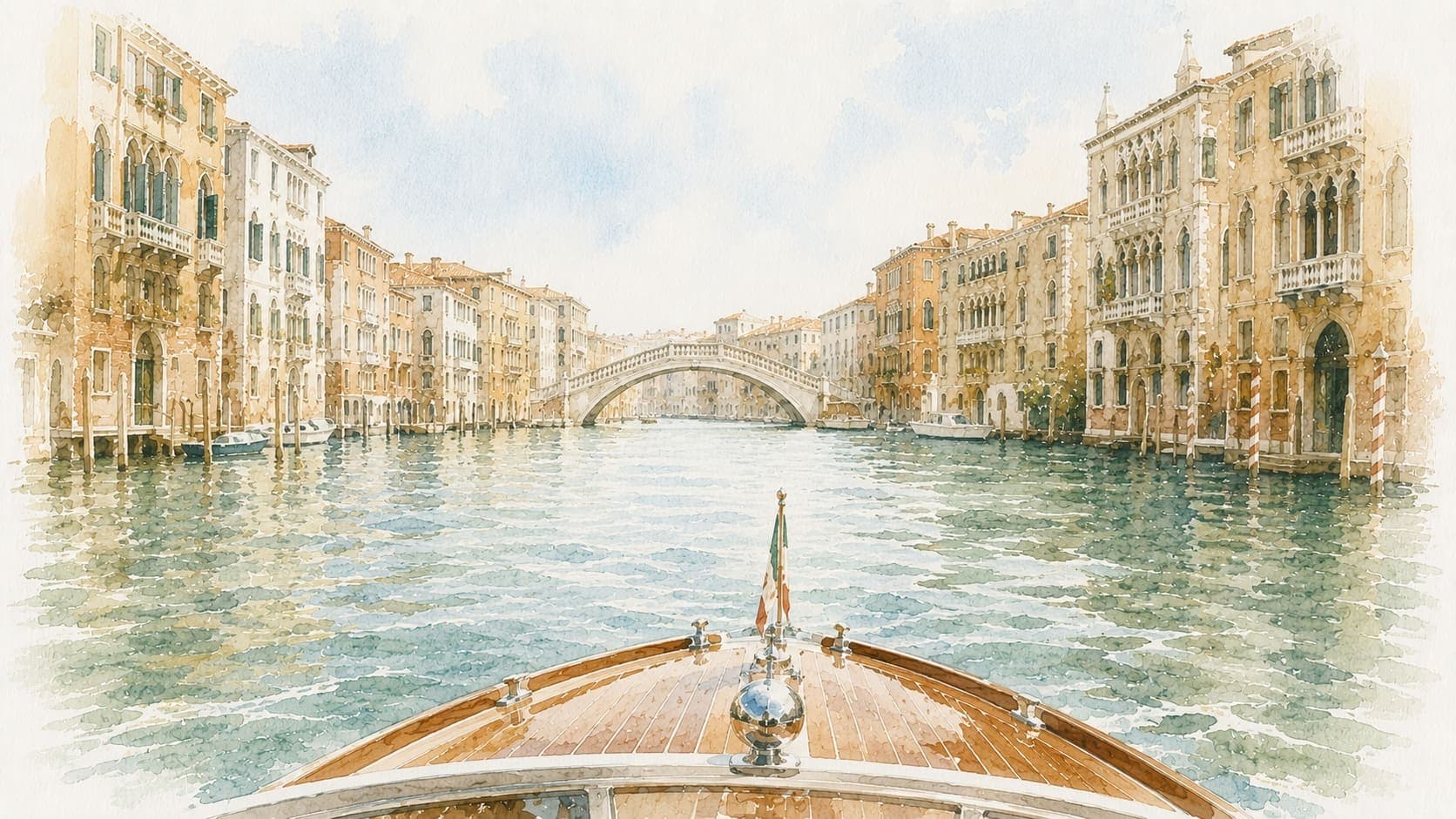
Private boats (motoscafi) are a legitimate and, frankly, a lovely way to arrive. But at the airport you're pulled out of the official queue, and unlicensed boats invent the fare as they go: a surcharge per passenger, per bag, for the night, a detour "on the way." A benchmark for the real price: airport to the historic centre is roughly €120–160 per boat (per boat, up to eight or ten people with luggage), 25–30 minutes; a short hop within the city, €60–80.
How not to fall for it. Take a boat only from the official Consorzio Motoscafi rank, or book ahead. Agree the total — per boat — before departure, and don't go with anyone who approaches you away from the rank. Better still, an arranged transfer removes the question entirely: you're met, your luggage is loaded, and you're at your hotel door in twenty-five minutes, with no meter and no negotiation on the jetty.
"Skip the line" and guides without a licence
By the Doge's Palace and on the approaches to St Mark's, people sell "skip-the-line tickets" and "tours" off the street — dearer than the box office and with no guarantee whatsoever. A separate matter is people who call themselves guides without a licence. In Italy the right to lead a tour is confirmed by an official patentino, and a real guide carries it. Someone off the street will, at best, recite an internet article to you; at worst, steer you into that same shop or restaurant for a commission. On top of that, only licensed guides may lead a group inside the Doge's Palace and the museums — the rest will leave you at the door.
How not to fall for it. Buy tickets only through the museum's official channels. Take only a licensed guide; asking to see the licence is entirely normal and won't trouble a professional. If you care about both the substance and skipping the queue, that should be one person with a patent, not two strangers.
The bracelet, the rose and the petition
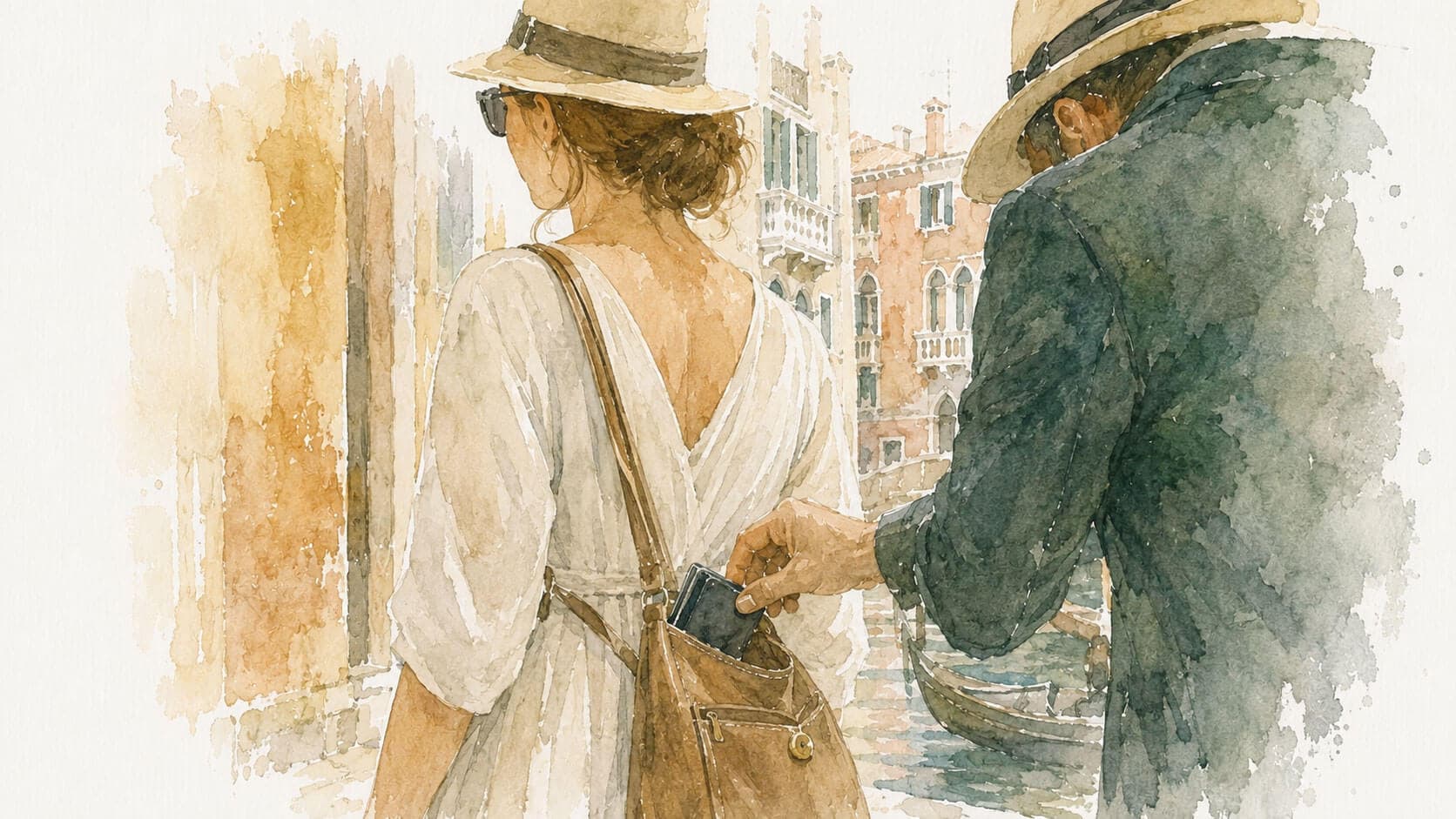
A staple of crowded spots — St Mark's, the Rialto, the station, a packed vaporetto. You're "given" a bracelet, it's tied to your wrist, and then money is demanded. A rose is held out "for the lady" — again, payment is expected. A petition is pushed at you "to sign for a good cause" — and while you take it in, pockets are worked. There's also the trick of a ring "found" at your feet.
How not to fall for it. A firm "no," and let nothing be put on you. Take nothing into your hands — keep them in your pockets. Carry your bag in front of you and fastened, especially in a crowd and while boarding a vaporetto. There will be no violence here: the whole scheme rests on confusion and good manners, so it's enough not to yield to the first move.
"Pay in your own currency?" and other small change
The least visible losses are not on the big things but on the small ones. A card terminal or a cash machine asks whether you'd like to pay "in your own currency" — in pounds or dollars rather than euros. This is DCC, dynamic currency conversion at a poor rate with a mark-up; always choose euros. At the vaporetto ticket machines, a "helpful" assistant takes a commission for the couple of taps you'd have made yourself. A paid loo, a "photo with a gondolier," water by St Mark's at triple the price — trifling on their own, but they add up over a day.
How not to fall for it. On any terminal, pay in euros. Buy your tickets yourself, at the machine or in the app. And keep one simple rule in mind: the closer to St Mark's, the higher the mark-up on everything, from an espresso to a bottle of water.
Quick reference
- Gondola
- €90 by day, €110 in the evening, per boat of up to five, not per head.
- Restaurant
- prices visible before you sit; ask about any fish "by weight" in advance.
- Murano
- go yourself by vaporetto and look for the Vetro Artistico® Murano mark.
- Water taxi
- official rank only, total agreed before departure.
- Tickets and guide
- official box office and a licence, never an offer off the street.
- Crowds
- hands in pockets, bag in front, decline "gifts."
- Terminal
- always euros; no help needed at the machines.
Frequently asked
Is Venice dangerous for tourists?
No. Violent crime is rare, and Venice is considered one of the safest cities in Italy. The main risk to a visitor is to the wallet rather than from a thief: overpaying for a gondola, a bill in a tourist restaurant, a padded water-taxi fare. All of it is manageable if you know the fixed prices and the rules.
How much does a gondola ride cost?
The fare is set by the city: €90 for 30 minutes by day and €110 for 35 minutes in the evening. The price is for the whole boat (up to five people), not per person, and payment is cash. A serenata with musicians is charged separately, from €200, and is agreed in advance.
Do I have to pay the coperto in a restaurant?
Yes, if it's stated on the menu: the coperto is a legal cover charge, usually €2–6 per person, and it must be shown in advance. The service charge (servizio, 10–12%) is a separate line — check it hasn't been added to your bill automatically.
How do I get in from the airport without overpaying for a boat?
Take a water taxi only from the official Consorzio Motoscafi rank, or book ahead. Expect around €120–160 per boat to the historic centre, 25–30 minutes. Agree the total before departure and don't go with anyone touting away from the rank.
How do I tell real Murano glass from a fake?
Look for the official Vetro Artistico® Murano mark — it guarantees origin. Buy on the island itself, by the working furnaces, rather than in a tourist shop near St Mark's, where most "Murano" souvenirs are imported. A full guide is in a separate article.
How do I check that a guide is licensed?
Ask them to send a photo of the badge or patentino while you're still corresponding — a professional will do so without taking offence. Only licensed guides may lead tours inside the Doge's Palace and the city's museums; a guide off the street can't offer that access.
Venice doesn't punish the tourist — it rewards the one who knows the rules. Not one of these schemes is dramatic; each is simply a tax on not knowing, and it's lifted in advance — by the fixed price, the small print, the knowledge of how things are done. That is precisely the point of a licensed guide: not to "show you more," but to move you through the city without friction — without the overcharges, without the wrong turn into the wrong restaurant, without the negotiation on the jetty. If you're planning a visit, tell us your dates and we'll build the route and the logistics around you. And to start walking a city of substance rather than signage right now, take our curated map of Venice with you.